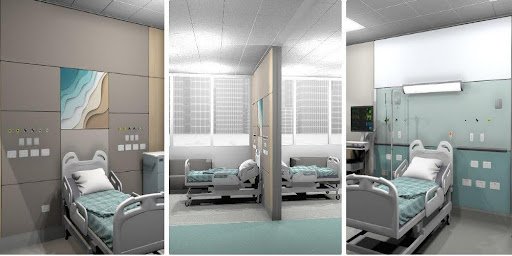
The Value of Integrated Medical Headwalls in Healthcare
Integrated medical headwalls are becoming a critical element of modern healthcare design, particularly within NHS hospitals and other UK healthcare settings. Far more than a “nice to have”, they are now recognised as essential infrastructure that directly influences patient safety, clinical efficiency, staff wellbeing and the overall patient and family experience. By intelligently integrating medical gases, power, data, storage and equipment management into one carefully designed unit, headwalls help transform ordinary patient rooms into safer, more functional and future-ready clinical environments.
Why Integrated Medical Headwalls Matter in Modern Healthcare Settings
In an era of increasing demand on NHS services, pressure on bed capacity and the need to do more with existing estates, integrated medical headwalls offer a practical, evidence-based way to improve ward performance. They support better patient room design, enable more efficient use of clinical space and help standardise the clinical environment across wards and departments. For estates teams and clinical leaders alike, headwalls provide a means to modernise hospital infrastructure without always needing full-scale rebuilds.
By consolidating critical services into a single, well-planned unit at the bedside, integrated headwalls can reduce clutter, simplify room layouts and improve visibility and access to essential equipment. This has a direct impact on patient care quality, as staff can respond more quickly and safely, and patients benefit from a more organised, calmer environment. In short, integrated medical headwalls sit at the intersection of clinical need, design quality and operational efficiency in modern healthcare facilities.
Integrated Medical Headwalls? Components, Functions and Design Basics
An integrated medical headwall is a coordinated system built into the wall behind or beside the patient bed that brings together the key services required at the point of care. Unlike traditional, piecemeal installations of individual outlets, trunking and brackets, an integrated headwall system is designed as a complete, modular solution.
Typical components include medical gas outlets (such as oxygen, air and vacuum), electrical sockets, data points, and nurse call facilities, all grouped logically for clinical use. Many systems also incorporate built-in storage for frequently used items, equipment management rails, lighting controls and space for monitors or infusion devices. This integration reduces the need for ad-hoc fittings and temporary solutions that can make rooms difficult to manage and maintain.
Headwalls are available in both vertical and horizontal configurations, with modular headwalls allowing layouts to be tailored to specific clinical needs, room types and bed locations. Configurations can be optimised for different care levels, from standard inpatient wards to high dependency and intensive care units. Clinical utility panels can be arranged in standardised formats so staff always know where to find essential services, regardless of which ward they are working on. Ultimately, the design basics focus on combining clinical safety, ease of use and aesthetic integration with the wider patient room.
Improving Patient Safety: How Integrated Headwalls Reduce Risk at the Bedside
Patient safety is one of the strongest arguments for adopting integrated headwalls in NHS and other healthcare settings. By providing clear, organised access to medical gases, power and data at the bedside, headwalls reduce the need for trailing leads, extension cables and temporary equipment placements that create trip hazards for staff, patients and visitors. Effective cable management and built-in mounting points help keep the floor and immediate bedspace clear, supporting safer movement around the patient.
From an infection prevention perspective, integrated headwalls can be designed with smooth, cleanable surfaces, minimal joints and concealed services, all of which help reduce dust traps and make it easier for cleaning teams to adhere to protocols. Standardised layouts also support faster, safer emergency responses: when every bedhead has a consistent arrangement, staff can locate oxygen, suction and power instantly, even when working in unfamiliar wards or under pressure.
Human factors design plays a key role, ensuring that critical controls are easy to see, easy to reach and clearly labelled, aligning with NHS safety standards and wider clinical governance requirements. This reduces the risk of errors at the bedside and supports safer care for patients in both routine and emergency situations.
Boosting Clinical Efficiency and Workflow for Multidisciplinary Teams
Integrated medical headwalls can significantly improve clinical workflow for nurses, doctors, therapists, and other members of the multidisciplinary team. By bringing essential services and equipment within arm’s reach, they reduce the time staff spend searching for outlets, repositioning equipment or reconfiguring the room around each new patient.
This time saving translates into more time for direct patient care, better communication with families and less frustration for staff. Ergonomic design features, such as well-positioned sockets and gas outlets, height-appropriate shelves and intuitive layouts, help reduce unnecessary bending, stretching and lifting, contributing to lower staff fatigue over the course of a shift.
A less cluttered environment, enabled by integrated equipment management and storage, makes it easier to maintain a tidy bedspace, quickly prepare for admissions and accelerate patient turnover when required. For ward managers, these factors support improved ward efficiency and staff productivity, ultimately benefiting both operational performance and quality of care.
Enhancing the Patient and Family Experience Through Better Room Design
From a patient’s point of view, the design of their room has a powerful influence on how safe, respected and comfortable they feel. Integrated headwalls help create a calmer, more organised and less “clinical” visual impression by reducing visible clutter, concealing some services and allowing a cleaner, more coordinated aesthetic.
This supports privacy and dignity, as rooms can be laid out more thoughtfully, with better separation between clinical equipment and personal space. Quieter wards are also easier to achieve when equipment is properly fixed, cables are managed and devices are not constantly being moved or knocked.
A well-designed headwall contributes to a therapeutic environment: lighting can be better controlled, visual distractions reduced, and spaces created that feel more family-friendly, encouraging relatives to stay and participate in care where appropriate. Over time, these improvements can help boost patient satisfaction scores and be reflected in NHS patient feedback, reinforcing the value of investing in high-quality room design.
Supporting Flexible Care Models: From Acute Wards to High-Dependency and ICU
The NHS and wider UK healthcare system increasingly rely on flexible care models that allow beds and wards to adapt to changing acuity levels, seasonal pressures and unforeseen events such as pandemics. Integrated headwalls are a key enabler of these flexible care environments.
By designing acuity-adaptable rooms with headwalls that can support both standard and higher-dependency care, hospitals can more easily step patients up or down in intensity without needing to transfer them to a completely different ward. HDU and ICU headwalls can incorporate higher levels of gas outlets, power capacity and equipment mounting points while still maintaining a consistent underlying design philosophy.
This flexibility enhances surge capacity and emergency preparedness, making it easier to respond to peaks in demand, cohort patients and manage crisis situations. From a long-term perspective, adaptable headwall infrastructure helps future-proof wards against evolving clinical practices, new technologies and changing patient demographics.
Space Optimisation and Better Use of Existing Estates
Many NHS hospitals operate within constrained estates, with limited scope for expansion. In this context, space efficiency becomes crucial. Integrated headwalls offer compact, carefully planned solutions that maximise the usable bedspace around each patient.
By consolidating services into a smaller footprint, headwalls free up floor area for staff movement, equipment parking or family seating. They are particularly valuable in refurbishment projects and retrofit scenarios, where there is a need to modernise legacy buildings without major structural alterations.
Headwalls can support ward reconfiguration, enabling existing spaces to be re-planned to accommodate more beds, improve flows or separate different patient groups. For estates and facilities teams working within a broader healthcare estates strategy, integrated headwalls provide a practical tool for modernising older infrastructure while making best use of the available footprint.
Infection Control and Cleanability: Designing for Safer Healthcare Environments
Infection control remains a top priority across UK healthcare. Integrated headwalls can be designed from the outset with cleanability and hygiene in mind. Smooth, non-porous surfaces, minimal seams and integrated trunking help reduce areas where dust and pathogens can accumulate. Concealed services limit exposed pipework and wiring, supporting more effective cleaning.
Materials can be selected for their durability under frequent cleaning and compatibility with standard NHS cleaning protocols. Options such as antimicrobial finishes can further support efforts to reduce healthcare-associated infections. Crucially, well-designed headwalls can help trusts meet relevant HTM (Health Technical Memoranda) and HBN (Health Building Notes) guidance, aligning with UK regulatory expectations for infection-safe design.
Technology Integration: Powering Digital Health at the Bedside
Modern healthcare is increasingly digital, and the bedside is a focal point for this transformation. Integrated headwalls can support the “digital hospital” by providing structured access to power, data and connectivity exactly where it is needed.
Features may include integrated nurse call systems, connectivity to medical devices and monitors, and bedside access points for electronic patient records. Patient entertainment systems, USB and power outlets for personal devices, and bedhead lighting controls all contribute to a more responsive, technology-enabled care environment.
Smart headwalls can serve as a physical platform for future digital innovations, supporting remote monitoring, real-time data capture, and improved communication among staff, patients, and systems. By planning for technology integration from the outset, hospitals can avoid ad-hoc additions that undermine both aesthetics and safety.
Cost, Value and Total Cost of Ownership: Making the Business Case
While integrated medical headwalls require capital investment, their value must be assessed over the full life cycle rather than on initial cost alone. A robust cost-benefit analysis should consider not only purchase and installation but also operational savings, maintenance costs and the avoided expenses of repeated refurbishments and temporary works.
By reducing downtime, minimising the need for multiple trades to adapt bedspaces over time and supporting more efficient care delivery, headwalls can lower long-term operational costs. Fewer refurbishments, better durability and easier servicing all contribute to a more favourable total cost of ownership.
For NHS procurement teams, value engineering and long-term investment thinking are vital. Integrated headwalls can help trusts achieve strategic goals around safety, efficiency and estate modernisation, supporting a persuasive business case and a clear return on investment over many years of service life.
Installation, Compliance and Working with Design Standards in the UK
Successful headwall projects depend on careful planning, coordination and compliance with UK healthcare regulations. Working within the framework of HTM and HBN requirements, designers, architects and M&E engineers must ensure that headwall systems meet all relevant technical and safety standards.
The process typically includes detailed design and specification, installation by qualified contractors, and rigorous commissioning, testing and certification before clinical use. Close collaboration between clinical teams, estates departments and suppliers are essential to align the final configuration with real-world workflows and NHS guidelines.
By embedding compliance and best practice into every stage, from planning to handover, organisations can ensure that integrated headwalls deliver not only functional benefits but also regulatory assurance and patient safety.
Key Considerations When Selecting Integrated Medical Headwalls
When choosing integrated headwalls, decision-makers should consider a wide specification checklist. This includes current and future clinical requirements, flexibility for future expansion, and compatibility with existing medical gas, electrical and ICT systems.
Customisation options are important to ensure that layouts suit local workflows while still enabling sensible standardisation across an organisation. Supplier selection should take into account not only product quality but also warranty, aftersales support, training for clinical and estates staff, and the supplier’s track record within UK healthcare.
Sustainability and energy efficiency are increasingly central to procurement decisions. Headwalls that support low-energy components, durable construction and easy maintenance can contribute to trust-wide environmental goals as well as long-term cost control.
Unlocking the Full Value of Integrated Medical Headwalls in UK Healthcare
Integrated medical headwalls offer a powerful combination of benefits: safer patient care, more efficient workflows, a better experience for patients and families, and long-term value for healthcare providers. For NHS organisations seeking to modernise their estates, improve clinical safety and work more productively within constrained resources, headwalls represent a strategic investment rather than a purely technical upgrade.
By approaching headwall implementation through the lens of evidence-based design, trusts can ensure that each project aligns with clinical priorities and delivers measurable improvements. The opportunity now is to integrate headwalls into refurbishment and new-build programmes as standard practice, planning the next ward or department upgrade with integrated headwalls at its core.
For those responsible for estates, clinical design or capital planning, the message is clear: to unlock the full value of your hospital infrastructure, make integrated medical headwalls a central part of your strategy.
Thoughtfully specified and well-implemented, they can help reshape care environments across the UK, supporting better patient outcomes and more sustainable, efficient working for staff.
Share this content:













Post Comment